
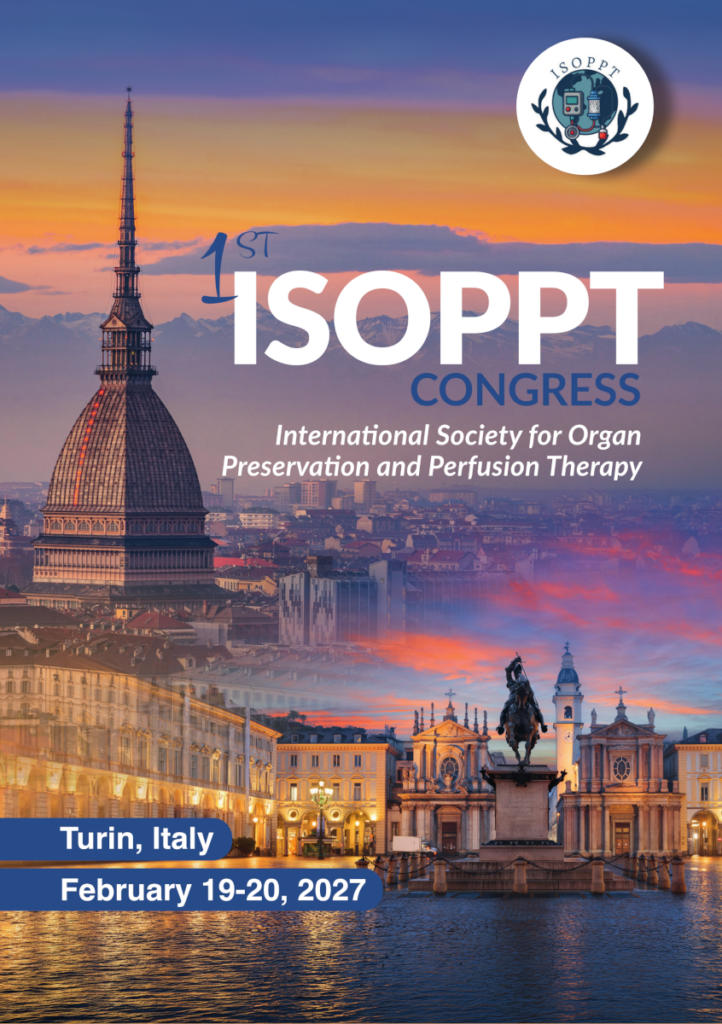
1st ISOPPT Congress · Turin, Italy · 19–20 February 2027
Call for Abstracts
Submit original research in organ preservation, machine perfusion and perfusion therapy.
OVERVIEW
call for abstracts
ISOPPT invites clinicians, surgeons, transplant professionals, scientists, engineers, researchers and trainees to submit original research for the 1st ISOPPT Congress.
Relevant clinical, translational, scientific and engineering work may be considered for oral or poster presentation.
- Present to an international multidisciplinary audience
- Share advances in organ preservation and perfusion
- Connect with clinical, scientific and engineering colleagues
important dates
Abstract submission opens
September 25, 2026
Abstract submission deadline
November 22, 2026
Acceptance notification
December 15, 2026
1st ISOPPT Congress · Turin
19-20 FEB 2027
Congress topics
The congress topics are organized into five thematic areas spanning organ preservation, machine perfusion, assessment technologies and translational applications.Congress topics
- Machine perfusion diffusion across the world: kidney, liver, heart and lungs
- HOPE vs. NMP in liver transplantation: first comparative studies
- Machine perfusion in kidney transplantation: indications, techniques and outcomes
- Benefits and pitfalls of ex vivo lung perfusion
- Heart machine perfusion: cold vs. warm vs. new-generation hypothermic preservation
- Different machine perfusion implementation models: industry-provided service vs. hospital-driven
- Viability assessment in liver, kidney, heart and lung transplantation: where do we stand?
- Sensors for real-time biomarker determination and viability assessment
- Data flow and digital twins: towards perfusing virtual livers
- Artificial intelligence and machine perfusion: towards better risk stratification?
- Progress in NRP diffusion across the world
- NRP technology: opportunities to improve current practice
- NRP and subsequent machine perfusion: when and what
- Thoraco-abdominal NRP, ex situ machine perfusion and heart transplantation: alternative or complementary strategies?
- Machine perfusion to enable minimally invasive liver transplantation
- Machine perfusion immunomodulation and implications for post-transplant immunosuppression
- Machine perfusion and recipient infection: friend or foe?
- Organ interventions during machine perfusion
- Machine perfusion and xenotransplantation
- Machine perfusion in transplant oncology
- Long-term machine perfusion: clinical vs. research platform
- What is new in standard cold static preservation?
- Cold static preservation at 10°C
- Cryopreservation and supercooling
- Extracorporeal organ function-supporting devices: ECMO, liver systems and LVAD
- Liver resection under machine perfusion: ex situ and in situ approaches for tumours or splitting
- Ex situ machine perfusion as a platform for drug testing
- Machine perfusion beyond transplantation
Abstract Submission Categories
Select the category that best matches your abstract in the Microsoft Forms field “Abstract Category.” These submission categories are distinct from the broader Congress scientific topics above.
01 Drug testing
02 Thoracic organs
03 Abdominal organs
04 Other organs
05 ECMO
06 Artificial organ support systems
07 Bioengineering
08 Mechanical engineering
09 Research models
10 Viability assessment
11 Biosensors
Submission Guidelines
A
Abstract structure
- Title
- Background / Introduction
- Methods
- Results
- Conclusions
B
Format
Language English
Maximum word count 300 words
Keywords Up to 5
C
Scientific content
Use accurate, clear and concise scientific language.
Do not include directly identifiable patient information.
D
Authors
Provide the presenting and corresponding authors, all co-authors, degrees, institutional affiliations, email and country as applicable.
The submitting author must ensure every listed co-author has reviewed and approved the abstract.
Policies
Required disclosures
Authors must disclose whether substantially similar work has been published, accepted for publication or presented at another scientific meeting. Final policy is subject to Scientific Committee approval.
Authors must disclose relevant financial relationships or other interests related to the submitted work.
Any generative AI used in preparing the abstract must be identified by tool/service, purpose and author oversight. Authors remain responsible for the accuracy, integrity, originality and final content.
Submissions involving human participants, data or materials, or animal research, must disclose the applicable ethics review status, institution and approval/reference number where applicable. Final wording remains under committee review.
Accepted abstracts may be assigned an oral or poster presentation. The presenting author will be responsible for responding to notification and completing congress registration.
Abstract Submission
Submit an Abstract
The Abstracts submission will open on September 25, 2026.
Abstracts are submitted securely through an online form. Please review the submission guidelines before submitting.
The submission form will open in a new tab.
FAQ
Frequently asked questions
Clinicians, surgeons, transplant professionals, scientists, engineers, researchers and trainees working in organ preservation and perfusion therapy are invited to submit.
Work relevant to the Congress scientific topics listed above is appropriate. Each abstract must be assigned to one of the 11 Abstract Submission Categories.
The abstract body is limited to 300 words.
Authors should submit original research, not having previously been published in a scientific journal. Previous presentation at congress or meeting of unpublished research does not represent an exclusion criterion. Authors will be asked to disclose prior publication or presentation.
Yes, you may state a preference, but it does not guarantee assignment. The Scientific Committee will determine the final format.
Reviewers will score scientific significance, methodological rigor, innovation, relevance and clarity.
Acceptance decisions will be sent by December 15, 2026.
Presenting authors will be required to complete congress registration; the deadline and final presenter rules are to be confirmed.
Organizing Secretariat: Planning Congressi srl. Email Michela Gorgoglione or Vanessa Grotti. Visit isoppt.org/congresses.